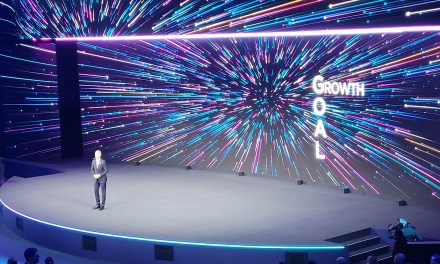


Google used its I/O developer conference this week to preview a major new m-payments service, an Internet of Things (IoT) platform, and the latest version of the Android smartphone OS.
Android is used by 1 billion people worldwide and in recent years Google has begun to extend the software from smartphones and tablets to new form factors such as wearables, TVs, and cars.
"We started with just one phone, and today we serve 400 OEMs, 500 carriers and over 4,000 devices," said Sundar Pichai, senior vice president of Google, in a streamed keynote presentation on Thursday. "The same journey is underway in each of these areas."
Indeed, Google’s wearable platform Android Wear has shipped on seven different smartwatches, while Android Auto will have shipped on 35 car models by the end of 2015.
With more and more device types becoming connected, Google is working on a way to make it easier for them to communicate with one another. Enter ‘Project Brillo’, an IoT platform consisting of a communication protocol called Weave, a set of developer APIs, a certification programme and reference design s.
"We’re committed to fostering a vibrant ecosystem in which we all work together to move the industry forward," said Google, in a statement.
Google also announced plans to compete directly with Apple Pay, with the launch of Android Pay – a contactless payment service supported by household names in the payment and banking sector, such as American Express, Discover, Visa, Mastercard, and Citibank, among others.
When Android Pay launches later this year, users will be able buy goods and services over near field communications (NFC) at 700,000 retail outlets.
Google’s mobile journey all started with Android on the smartphone though, and this journey is set to continue with the unveiling of the latest edition of the mobile operating system.
Android ‘M’ – its sweet/dessert nickname has yet to be designated – will not usher in major changes to the interface and how it functions, rather it will correct bugs in the software and make a multitude of minor tweaks and updates in a bid to improve the user experience.
We have "gone through it and made it better," said Pichai.
One such change has been to give users much more control over what an application is permitted to access on a handset, such as location, the contact book, the camera, or the microphone, among others.
Android M will also support fingerprint identification, and USB Type C (USB-C), the latest version of USB connectivity that uses a symmetrical cable. USB-C also supports bi-directional power, so a handset can either be charged or used as a charger for another device.
"For M we have gone back to the basics, we’ve really focused on polish and quality," Pichai said.
Android M is due to start shipping in the third quarter.