
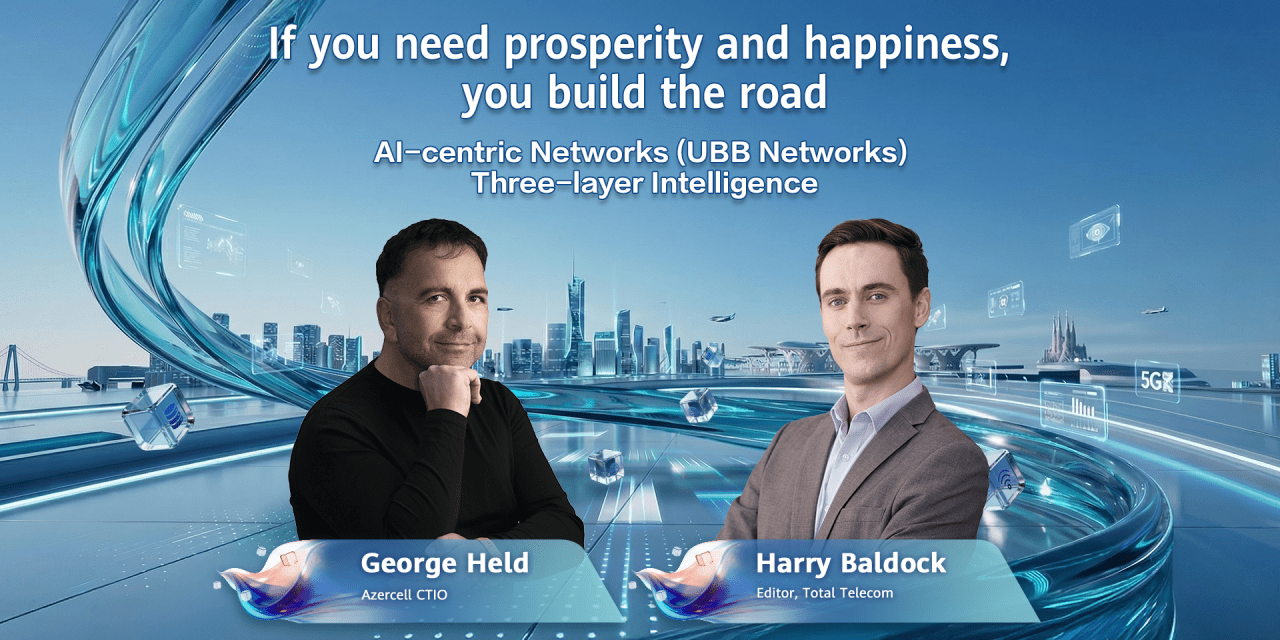
At MWC 2026, we caught up with George Held, CTIO of Azercell, on how the company’s infrastructure is turning Azerbaijan into a regional digital hub
Speaking to Total Telecom at the WinWin studio, Held explained how Azercell’s infrastructure backbone was a key foundation for the nation’s future growth.
“In our part of the world, we have a saying: if you want happiness and prosperity, you build a road […] In our world nowadays, it’s building a digital road,” he explained.
In recent years, Azercell has focused on nationwide fibre deployment, including upgrading to the latest GPON technology.
“At first, we built just a normal GPON network, and now we’re bringing it to GPON with speeds of 50gbps,” said Held.
This powerful network, Held said, holds the keys to capitalising on Azerbaijan’s strategic geographic position as a transit corridor linking Asia, Europe, and beyond.
“The role which we play is just absolutely unbelievable because we are connecting East and West, North and South. And by doing this, we are making life so much better for people in our countries. We’re bringing employment. We’re bringing opportunities. And, at the same time, we’re bringing the global economy together,” he said.
Embracing the AI era
Beyond deploying high quality infrastructure itself, Azercell is also implementing AI within network management, with a strong focus on developing autonomous, self-healing networks aligned with TM Forum frameworks. These systems dynamically reroute traffic and optimise performance in real time.
“With autonomous networks we will be able not only to connect people, but give different experiences, different speeds of connectivity. And some elements like low latency bring absolutely different experiences,” said Held. “We’re putting lots of elements on the network just to make sure that the experience for users is absolutely uninterrupted.”
Held pointed to major live events as proof points of this technology’s effectiveness, including the Azerbaijan Formula One Grand Prix and a recent Justin Timberlake concert in Baku.
“We were able to switch the traffic automatically from one place to another,” he said. “This delivered unprecedented experience to our customers.”
The same capabilities apply to environmental disruptions, including the harsh weather conditions faced in part of the country’s most mountainous regions.
“Huge winds, huge amounts of snow, rain — they all impact day to day operations,” said Held. “Self-healing networks address this by optimising traffic, bringing the capacity to the places where it really matters.”
From network performance to commercial growth
With a more optimised and resilient AI-powered network, opportunities for revenue growth are myriad.
“Commercial impact is fully related to the customer experience,” said Held, highlighting the importance of network reliability over pure speeds. “If we provided uninterrupted service, the volume of traffic would really see growth.”
Low latency is also becoming a key differentiator, particularly for cross-border traffic and AI applications.
“Latency […] is starting to play a really important role,” he said, noting its importance for emerging enterprise services and emerging use cases. “With low latency, all AI advanced applications and all the automatic processing is done in a much more elegant way.”
In addition to better customer experience across a raft of new services, AI serving as a leveller, allowing junior engineers to learn more quickly and compete with senior colleagues that have many years more experience.
“Our young engineers came up with a really cool AI tool where all the documents [about the network] are actually installed into one database and they can use natural language processing to pull any of the documents, and the system gives you a response on the network,” Held explained. “It gives a chance for young kids out of the university to deliver quality of service and compete with somebody who has been doing the job for 20 years.”
More than this, it gives Azerbaijan an opportunity to compete on a global level.
“Innovation has no ZIP code,” said Held. “AI for us is not just a gimmick. It’s not something which is invented in Cupertino or Mountain View. It can be invented in Baku. It works in Baku and makes lives better for our people.”